InfraSpace
Out on the edges of human space, you can't build a city by spending credits. Instead, you'll have to put your first astronauts to...
- Intel, 64-bit processor
- macOS 10.13 or later
Description
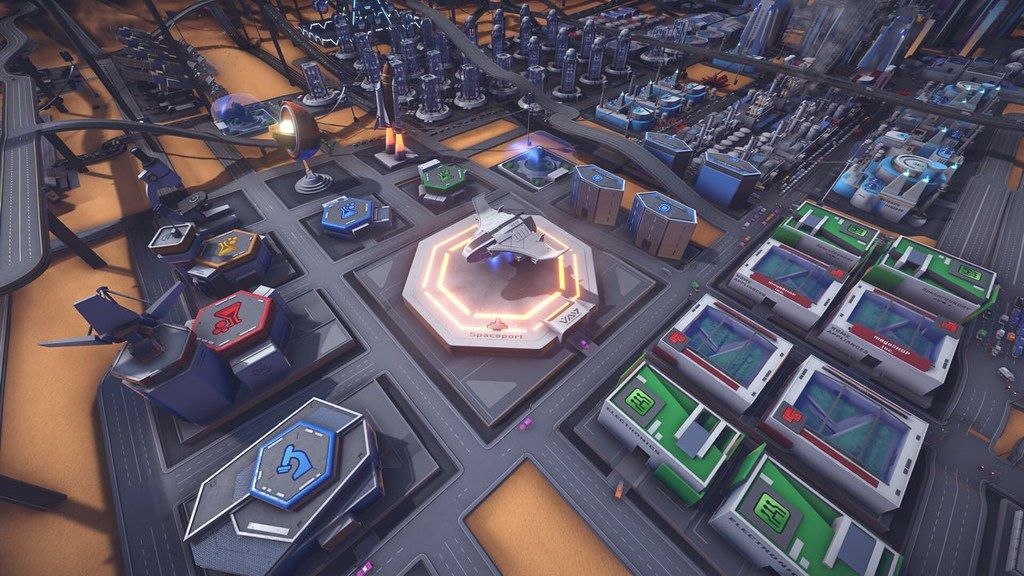
Out on the edges of human space, you can’t build a city by spending credits. Instead, you’ll have to put your first astronauts to mining work and get some raw materials. Once you have some iron, carbon, sand, and sulfur, it’s time to set up your first steel mill and concrete factory to start laying down some infrastructure.
Even necessities like food and oxygen require a steady production chain that must not be broken!
Transport Infrastructure
InfraSpace simulates every. single. car. Each resource you ever produce needs to be transported to a factory for processing and each product needs to go to a habitat for consumption. Your road network can handle a lot, but without your oversight it will grind to a halt and drown in traffic eventually. Build highways, roundabouts, and multi lane roads to ensure the production heart of the city keeps beating.
Trains, Pipes, and Cargo Lifts
Your road network might be versatile, but it’s not the right choice for every kind of resource – or the most fun one. Build rails and train stations to haul massive amounts of goods. Build underground pipes to pump liquids and gases all over the city. Build cargo lifts to reach the highest mountain tops and traverse even the most rugged terrain.
Population Growth
Your first colonists will be astronauts, the best and the bravest humanity has to offer. Give them food and shelter and they’ll keep your outpost running no matter what. As your settlement grows, you need to cover the increasing workload by employing scientists and engineers, which require a few more creature comforts. Any city of sufficient
size
will sooner or later be home to more and more families as well, so make sure your schools can handle it and you are able to deliver the latest VR-edutainment products as well.
Terraform the Planet
Living on a desert planet can be harsh – but you have your eyes set on the dream: Terraform the planet, make the desert green and the atmosphere breathable. It’s a huge undertaking, requirin
Editor-checked details
Recommended for players who enjoy Cities: Skylines-style transport planning, factory chains and space colonization. Do not optimize for a neat grid immediately: separate mining, processing and residential freight, reserving corridors for rail, pipes and dedicated cargo routes. Debug backward from demand building to final road, storage, processor and raw mine, including return traffic. In a large city, lower graphics first to identify GPU load before rebuilding traffic. Safe order: backup; 1.55.454/SHA-256; OS/architecture; fresh map; production; traffic; population; terraforming; mods; copied old city.
Pros
- Every car is simulated and resources physically travel from mines to factories and habitats, making traffic part of the production chain rather than decoration. Roads, rail, underground pipes and cargo lifts handle different goods and terrain, enabling real logistics layers. Population evolves from astronauts to engineers, scientists and families whose needs drive education, consumer goods and industry. Terraforming unifies oxygen, environment and massive supply chains into a long-term goal. Sandbox systems, technology, mods and data views reward repeated optimization, with 1.55.454 improving very-large-city simulation.
Cons
- Per-car simulation makes CPU bottlenecks increasingly likely as cities grow. Version 1.55.454 helps, but the developer explicitly warns that some traffic layouts may see no benefit. A shortage can require tracing several factories and road links, producing a dense learning curve. Road edits can merely move congestion elsewhere, while late population and terraforming chains are long. Visuals are functional, and GPU-bound performance does not benefit from this CPU optimization. Native Apple-silicon status and legacy OS listings require extra verification. Maintenance mode means fixes, not new features.
Installation steps
- This page covers channel version 1.55.454. The current official store minimum is macOS 11+, a 64-bit processor, Intel HD 4000-class graphics, 4 GB RAM and about 3 GB storage. The source page’s macOS 10.13 line is legacy information and should not be treated as the current Steam-client baseline. Back up cities and record SHA-256. With a fresh map, test mining, iron/carbon/sand/sulfur chains, food and oxygen, road direction, roundabouts/multilane roads, trains, pipes, cargo lifts, population tiers and terraforming. Confirm the desired interface language/font in settings. Intel is supported; native Apple-silicon status is not clearly documented, so validate the actual binary path on M1–M4.
Uninstallation steps
- Before uninstalling, pause simulation, save to a new slot and wait for Steam Cloud. Do not force-quit while a large city is saving, recalculating roads, mass-demolishing or changing a terraforming stage. Back up city files, mod list, the 1.55.454 installer and SHA-256. After reinstalling, disable mods/cloud first and verify production, transport and saving on a fresh map. Then copy the old city, enable mods one by one and restore cloud last, preventing an old mod or conflict from damaging the only save.
Common errors and fixes
- When a large city slows, identify the bottleneck: a large gain from lower graphics suggests GPU load; little graphics response plus slower simulation speed suggests CPU/traffic. Version 1.55.454 targets the latter. The developer observed 17–320% CPU speedups in very large cities, but some road layouts may see none. For congestion, inspect junctions, one-way flow, factory entrances and return trips instead of merely widening arterials; trains, pipes and lifts can separate freight. This build fixes laser-selected objects not turning red; if it persists, verify version and disable UI mods. Shortages usually trace to one broken resource, oxygen or transport link. On M1–M4, remove mods and confirm binary architecture first.
What changed in this version
- Official stable update 1.55.454 focuses on performance and fixes. CPU simulation in very large cities showed roughly 17–320% speedups, but results depend on the city, traffic layout and whether the game is GPU-bound; it will not materially raise GPU-limited frame rates. It also fixes some objects failing to turn red when selected for laser removal. The developer says the game is complete and in maintenance mode: bug fixes will continue, but no new features are planned.
File verification






Alternatives



Screenshots