Timberborn
Mankind turned Earth into a dry wasteland and perished, but some species adapted and evolved. Pick one of the beaver factions and see how...
- Intel, 64-bit processor
- macOS 10.13 or later
Description
Mankind turned Earth into a dry wasteland and perished, but some species adapted and evolved. Pick one of the beaver factions and see how long your colony can last.
Beaver societies
Control one of two beaver factions: the nature-friendly Folktails or the industrious Iron Teeth. Each faction has a unique style, buildings, and gameplay traits. Choose what fits your playstyle!
Wet and dry seasons
Prepare your settlement for recurring droughts. Stockpile on food and keep fields and forests alive even after rivers dry up. Rely on both natural water sources and artificial irrigation to keep the land arable.
River control
Beavers of the future have millennia of experience in water engineering. Put up dams and floodgates, dig canals with explosives, and redirect rivers to bring life back to the wasteland. Just be careful with that dynamite.
Lumberpunk
Turn timber into sophisticated machinery – from water wheels and sawmills to engines and shredders. Wood is the core resource in Timberborn, but the most advanced structures require metal. To find it, send your scavengers to the ruins of the old world.
Vertical architecture
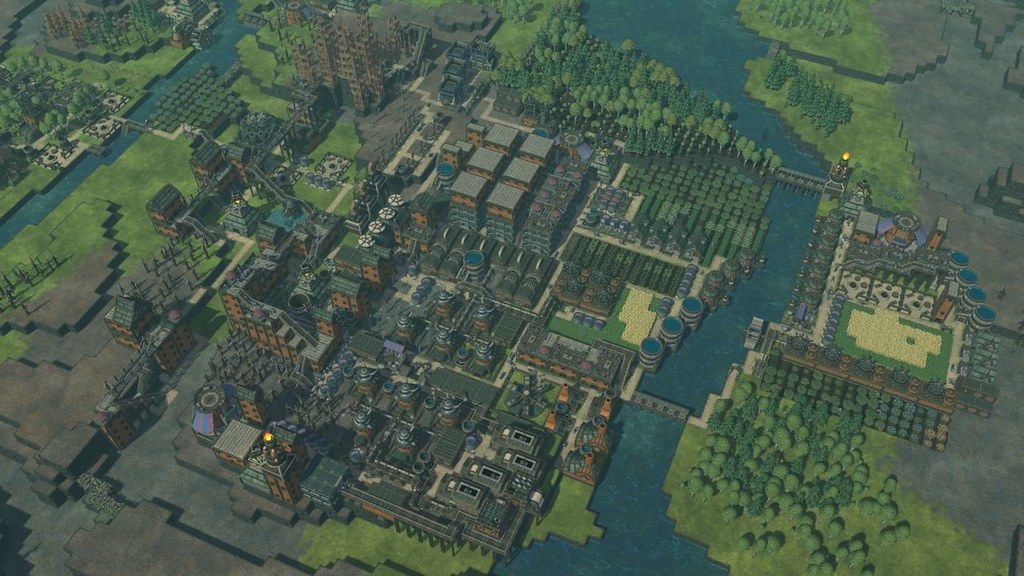
Create a thriving beaver settlement using a vertical architecture system. Space is limited, so stack lodges and workshops on top of each other, construct platforms and bridges, and set up a power grid for your growing population.
Day and night cycle
Build a multi-district city with efficient production chains and nighttime activities. Follow the lives of individually simulated inhabitants throughout their day and celebrate when the next generation is born!
Wellbeing
An evolved beaver’s lifestyle is not just “work, sleep and chomp on wood”. Satisfy the needs of your rodents with a balanced diet, decorations, monuments, and more – on top of keeping the colony alive.
Map editor
Play on one of the included maps or create your own and share it with the community! With hills of different heights, ruins scattered in the desert, and all life dependi
Editor-checked details
Recommended for players who enjoy city planning, logistics and an observe-before-altering rhythm, especially those willing to trace failure back to water level, paths and stock. For a first run, choose Folktails on a small map, pause to draw a main path, place housing on higher ground and reserve the valley for water and crops. Grow population only with surplus food, water and beds. Before the first drought, keep separate tanks, a deep closable reservoir and reserve food; avoid several material-heavy expansions at once. Make a separate save before every major river redesign. Safe order: verify M1/macOS; dual backup; record 1.0.13.0/SHA-256; small mod-free world; dam/drought; reload; old save.
Pros
- Its defining strength is moldable water physics rather than a generic resource chain: dams, floodgates, canals, pumps and terraforming tie wet-season storage, drought survival and city layout into one system. Vertical buildings, platforms, bridges and power shafts let production stack on scarce land. Folktails and Iron Teeth differ in reproduction, food, energy and signature structures, producing two planning styles on the same map. Well-being, day/night, districts, automation and long-term ecological recovery create readable mid- and late-game goals. The map editor and official mod support add longevity. English, Simplified and Traditional Chinese, Japanese and Korean interfaces are official.
Cons
- Water mistakes cascade: one wrong floodgate height, pump position or population forecast can break drinking water, crops, food and labor together, and autosave makes rollback costly. Paths, work range, storage rules, districts and power links overlap, while the UI does not always expose the true bottleneck. Large settlements put visible CPU and memory pressure on fast water simulation, pathfinding and inventories, so near-minimum Macs should limit population and map size. The factions differ meaningfully, but both repeat a long early sequence of logs, water and staple food. Current official Mac minimums start at Apple M1; Intel users should not rely on the old listing label.
Installation steps
- This page is strictly scoped to Timberborn 1.0.13.0. Official Mac minimums are macOS 13.0 or newer, Apple M1 or better, 8 GB RAM and about 3 GB free space; the older Intel/macOS 10.13 label on the listing is not a safe installation reference. Back up settlements, custom maps, difficulty and faction choices, mod list, shortcuts and graphics settings, then record the installer SHA-256. First launch without mods and create a small test settlement: validate logging and storage, pump and tank, crops, housing, paths and a power connection, then build a dam or floodgate and survive one drought. Check water flow, work range, stock, well-being and save reload before restoring an old world.
Uninstallation steps
- Before uninstalling, pause and let autosave, hauling and water simulation settle. Do not force-quit during map saving, a mod update or a sharp water-level change after removing a dam. Keep at least two rotating backups and record settlement, faction, cycle/day, population, food and water days, critical dam/floodgate heights, district stocks, power network, mod order and 1.0.13.0/SHA-256. After reinstalling, validate water, paths, jobs and saving in a fresh mod-free world before copying the old save. Restore the exact mod order before first opening it so missing buildings or recipes are not written permanently into the save.
Common errors and fixes
- Fast drought collapse is not solved by adding pumps alone: inspect reservoir depth, pump reach, storage capacity, population growth and crop demand, and bank water before the wet season ends. If construction stalls, check path continuity, work range, material storage rules, workers and priority in that order. For weak power, trace shaft direction and total supply/demand segment by segment. If a floodgate oscillates, avoid rapid large height changes; pause, adjust in small steps and let the surface settle. Version 1.0.13.0 improved Fill Valve targeting and added wave damping to Dams and Floodgates. For old-save crashes, copy the backup, disable mods and match 1.0.13.0 plus dependency order. For black screen or low frame rate, reduce shadows, view distance and simulation speed. Intel Macs are outside the current official minimum.
What changed in this version
- Site version 1.0.13.0 maps to the official 2026-04-20 main-branch patch. Master Builder achievements now remember structures that were built instead of checking only what remains on the map. Average well-being became a true rounded average. The Fill Valve algorithm was replaced to reach its target level more reliably, while Dams and Floodgates gained wave damping. Fixes covered the water-pump exploit, extra Folktail kits appearing after loading sleeping beavers, construction particles shifting status icons and the blurred Gate icon, with localization adjustments as well. Acceptance focuses on displayed 1.0.13.0, Fill Valve targeting, stable water behind a dam, well-being calculation, save reload and mod-free launch. No higher version number is shown here.
File verification






Alternatives



Screenshots